Pitwall 2026: F1 Race Analysis
Personal
I've been following F1 for quite sometime now, and the 2026 season felt like the most interesting one to actually dig into with data. The regulation changes this year are the biggest since 2014. A completely new power unit, the MGU-H deleted, and the MGU-K tripled in output from 120 kW to 350 kW. I wanted to understand what that actually looked like in the race numbers, not just read about it.
So I spent the mid-season break building this. I pulled lap timing data from FastF1 for the first three rounds and built out an analysis site from scratch.
Check out the project here!
What's in it
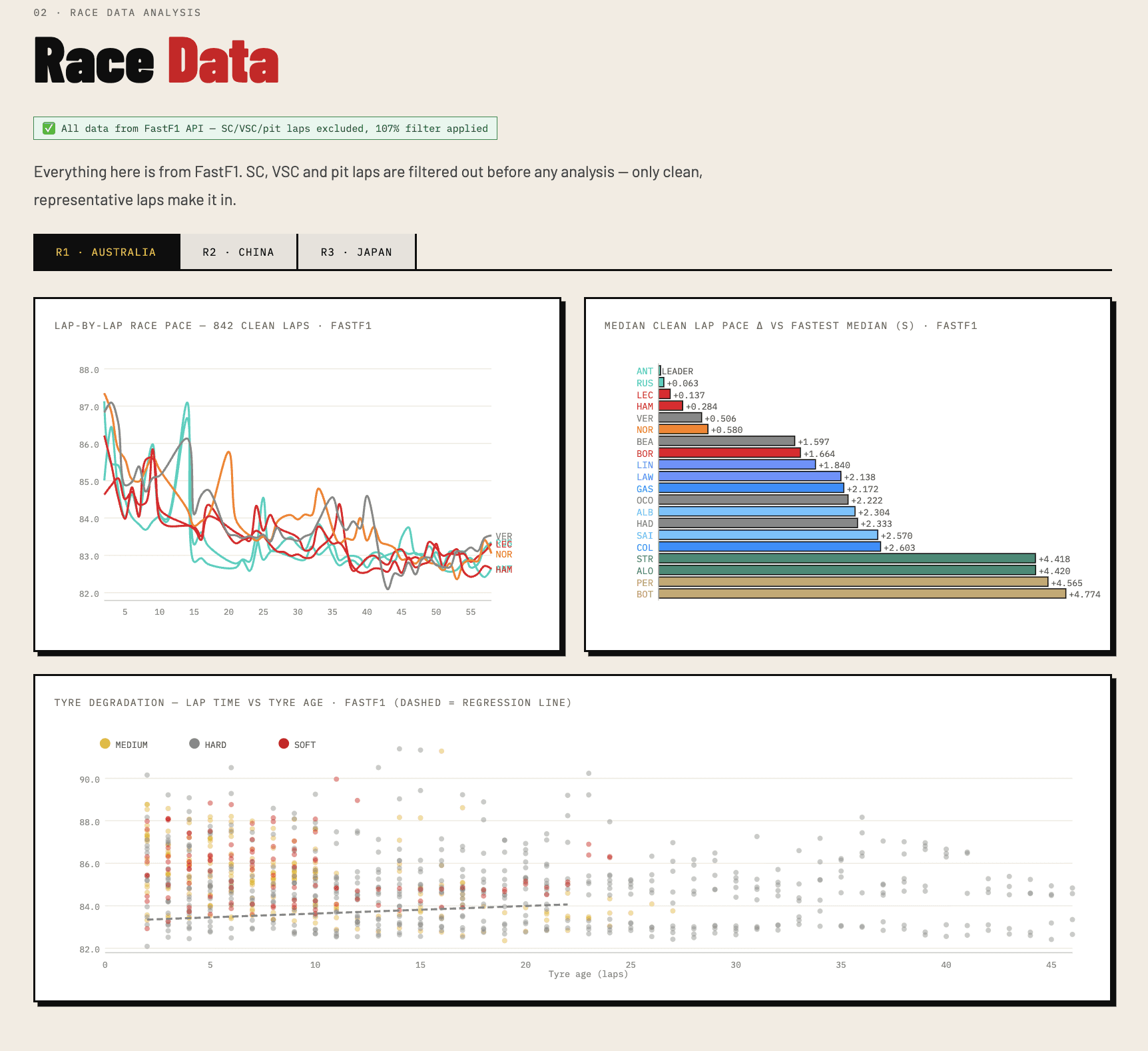
The site covers four things: a breakdown of the 2026 technical regulation changes and what they mean for how races are won; lap-by-lap race pace, sector splits and tyre degradation for all 22 drivers across Australia, China and Japan; a physics-based battery simulation modelling how the new Energy Store behaves across a full race distance; and a pace-based win probability model for the Miami Grand Prix.
Race data
Everything in the race analysis section is directly from FastF1. Safety car laps, VSC periods and pit entry/exit laps are filtered out before any analysis. Sector deltas show each driver's best sector time minus the field best, averaged across all three rounds. Tyre degradation is a linear regression of lap time against tyre age, per driver per compound.
Battery simulation
ERS and SoC data isn't in the public F1 timing feed, so I built a physics model using the FIA regulation constraints as inputs. The 4 MJ per lap SoC cap comes from Article 5.2.6 of the 2026 power unit regulations. The model runs three deployment strategies across a full race distance and tracks both charge level and temperature lap by lap using a lumped-parameter thermal model. The capacity fade curves use the Wang 2011 empirical formula for lithium-ion degradation.
The thing I found most interesting: thermal limits hit before energy limits under aggressive deployment. The battery gets too hot before it runs out of charge. That constraint is what changes circuit to circuit, not the energy budget.

Miami prediction
Miami, Canada and Monaco haven't been raced under the 2026 regulations yet, so there's no valid circuit-specific data to build weights from. The prediction is purely pace-based: recency-weighted median clean lap delta across the three rounds (Australia 20%, China 35%, Japan 45%), converted to win probabilities via softmax.
A note on process
Built with Claude as a coding assistant for debugging and layout. Data pipeline, modelling decisions and analysis are my own.